Facom Tools: Choosing Professional Hand Tools for Workshop and Trade Use
Professional tools are expected to perform reliably day after day, often in environments where accuracy and durability are essential. Mechanics, engineers, maintenance technicians and other tradespeople regularly apply considerable force through relatively small pieces of equipment, making tool quality an important consideration. Well-designed tools can improve efficiency, provide better control and reduce the likelihood of damaging fasteners or components during demanding work.
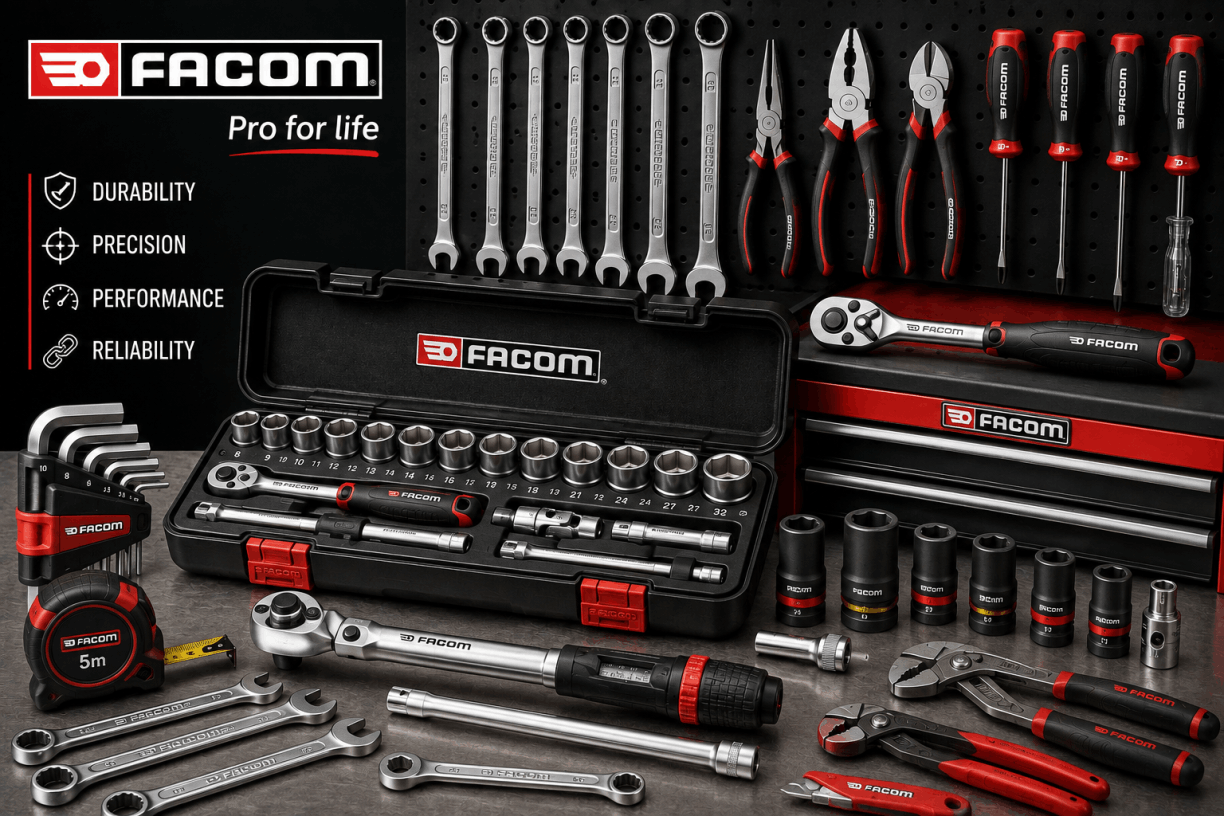
For professionals and enthusiasts researching Facom Tools, the range is particularly associated with hand tools, automotive equipment, workshop storage and specialist engineering products. From socket sets and ratchets to spanners, torque wrenches, screwdrivers and pliers, professional tool ranges are designed to provide solutions for both everyday maintenance and more specialised technical work.
Socket sets are fundamental to many mechanical toolkits. Selecting the correct socket ensures that force is distributed appropriately around the fastener, helping reduce the possibility of rounded nuts and bolts. A comprehensive collection will typically include commonly used socket sizes alongside ratchets, extension bars and other accessories.
Ratchet quality can have a considerable effect on usability. Fine-tooth mechanisms require less movement between engagement points, which can be particularly useful when working inside engine compartments or machinery where there is limited room to move the handle.
Different ratchet drive sizes are suited to different applications. Smaller drives provide compact access for lighter fasteners, while larger drive systems can accommodate the increased forces required for heavier mechanical work. Professionals will often keep multiple sizes available rather than relying on a single system.
Spanners remain equally important despite the convenience of socket tools. Combination spanners typically provide an open-ended profile on one side and a ring profile on the other, allowing the user to select the best option according to access and the type of fastener.
Ratcheting spanners can improve efficiency when working in restricted spaces. Instead of repeatedly removing and repositioning the tool, the internal ratchet mechanism allows the fastener to be turned through relatively small movements.
Torque control becomes particularly important in automotive and engineering applications. Many components must be tightened to manufacturer-specified torque values rather than simply being tightened as firmly as possible. Incorrect torque can potentially damage threads, distort components or result in fasteners becoming loose during operation.
A torque wrench allows controlled force to be applied to a fastener. Different designs are available for different torque ranges and applications, making it important to select a tool appropriate to the work being performed.
Torque tools also require appropriate care. They should be stored correctly and periodically checked or calibrated according to their type, usage and manufacturer recommendations. Precision equipment should not normally be treated in the same way as a general breaker bar.
Screwdrivers are another workshop essential. Modern machinery and vehicles use numerous fastener profiles, including slotted, Phillips, Pozidriv, Torx and hex designs. Using the correct driver profile helps provide secure engagement while reducing damage to the fastener.
Professional screwdriver handles are typically designed with ergonomics in mind. Shape, grip texture and material can influence how effectively torque is transferred while also affecting comfort during repetitive work.
Pliers and cutters perform a wide range of gripping, bending and cutting operations. Combination pliers provide general versatility, while long-nose designs are useful for accessing confined locations. Side cutters, circlip pliers, locking pliers and other specialist designs are intended for more specific applications.
Automotive technicians frequently require specialist tools beyond conventional hand equipment. Pullers, brake tools, diagnostic accessories, trim removal tools and other purpose-designed equipment can make specific repairs significantly easier and reduce the temptation to improvise with unsuitable tools.
Using the correct specialist tool can also help protect components. Modern vehicles contain plastic trims, electrical connectors and precisely engineered assemblies that may be easily damaged when inappropriate equipment is used.
Tool storage becomes increasingly important as a professional collection grows. A technician may accumulate hundreds of sockets, spanners and specialist tools over a career. Workshop cabinets, drawers and modular storage systems make it easier to organise this equipment logically.
Organisation is not simply about appearance. When every tool has a defined location, technicians can quickly identify whether something is missing before a vehicle or machine leaves the workshop. It also reduces time spent searching for equipment during a job.
Foam tool trays and fitted modules can provide an additional level of organisation. Each tool has a dedicated space, allowing missing equipment to be identified immediately while helping protect precision items from unnecessary contact and damage.
Durability is particularly important in professional environments. Tools may be exposed to oils, grease, moisture, chemicals and repeated mechanical loads. Appropriate materials, protective finishes and manufacturing tolerances all influence how well equipment withstands these conditions.
Even high-quality tools require maintenance. Equipment should be cleaned after particularly dirty work and stored somewhere dry. Ratchets and other moving mechanisms should be inspected periodically, while damaged equipment should be removed from service.
Tool inspection is also an important safety measure. Cracked sockets, worn spanner jaws or damaged handles can fail unexpectedly when significant force is applied. Continuing to use compromised equipment may save the cost of immediate replacement but can create a much greater risk of injury or component damage.
Breaker bars illustrate the importance of choosing the correct tool for the task. They provide additional leverage for loosening stubborn fasteners and are designed differently from ratchets. Using a ratchet with an extension pipe to create additional leverage can place forces on the mechanism that it was not designed to withstand.
The same principle applies throughout the workshop. Screwdrivers should not be routinely used as pry bars, pliers should not replace correctly sized spanners, and torque wrenches should not automatically be used for breaking seized fasteners loose.
For mobile technicians, tool portability becomes another consideration. A large workshop cabinet may provide excellent organisation in a permanent facility, while portable cases and bags are more suitable for field service and maintenance work.
Professionals may also consider how easily individual tools can be replaced or expanded. Tool collections develop gradually, so access to additional socket sizes, specialist attachments and compatible storage can become valuable over time.
For home mechanics and enthusiasts, purchasing professional-grade equipment does not necessarily mean buying everything at once. Building a collection gradually around frequently performed maintenance tasks can provide a more practical approach.
Starting with sockets, ratchets, spanners, screwdrivers and pliers creates a versatile foundation. Specialist equipment can then be added when particular repair or restoration projects require it.
The value of a tool should ultimately be considered across its entire working life rather than solely by its purchase price. Equipment that provides accurate fit, comfortable handling and dependable performance over many years may offer better long-term value than tools requiring frequent replacement.
Ultimately, Facom Tools represent the type of professional equipment commonly required across automotive, engineering, maintenance and workshop environments. By choosing appropriate sockets, spanners, torque tools, screwdrivers and specialist equipment—and maintaining them correctly—users can build an organised and dependable toolkit capable of supporting accurate, efficient and safer work for years to come.